
Maria Larionoff (ML): For our concert in April, you are playing the lovely “Lark Ascending” by Ralph Vaughan Williams plus two of your own arrangements of works by Pablo de Sarasate that were originally for violin and piano Over the years we have played others of your transcriptions, both here and with the American String Project in Seattle. How did this interest come about?
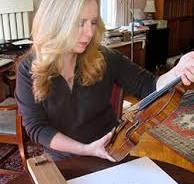 SC: I was probably influenced by the fact that my father, Bruce Chase, was a well-regarded arranger and composer, especially of works for orchestra. He studied violin and piano as a child living in Iowa, but it appears that he essentially ran away from home in his late teens and joined a dance band in the Northwest as a pianist. The band soon realized that because they had only a few instruments their repertoire was limited, and he was elected to make music arrangements.
ML: Where did he study this? It seems as if he did not go to college.
SC: No, he didn’t, and it was interesting to learn that my father was self-taught as an arranger and composer. But following a stint in the Navy during WWII he began working for television and radio studios in Chicago, back in the days when they had resident bands and orchestras. A few years before I was born, he was writing arrangements and conducting a band for a television show called “Super Circus” – and wore a special uniform, sort of like Robert Preston in “The Music Man”! Shortly after that he spent quite a few years working for “Don McNeil’s Breakfast Club,” which was a popular, nationally-broadcast morning radio show.
By the early 70’s, however, this kind of work was fast disappearing and the “Breakfast Club” had ended its run, so he practiced the violin and joined the Milwaukee Symphony Orchestra as a second violinist, where he remained until his retirement. For their Pops programs they frequently featured some of his arrangements and had him conduct, and he became something of a mascot for the orchestra. He also wrote and published albums of music to be used in educational programs from grade through high school level, and his arrangements, especially medleys, are still performed by symphony orchestras throughout the world.
ML: So how did you get started in this field, and what kind of approach do you take?
SC: I don’t really recall, but I started imagining music that I liked and played in a slightly different setting, with an increase in its tonal effects – sort of like “surround sound” versus what comes out of a piano. I am also self-taught in this but tend to restrict what I do to string ensembles because I am less comfortable writing for full orchestra with brass, wind, and percussion instruments, and have a profound respect for high school music teachers, who often have competence in playing and teaching a wide assortment of instruments.
If I am arranging something for violin and string orchestra that was originally accompanied by piano, I start by taking its part and dividing the left and right hands into the bass and treble instruments. Often, I add little original bits or make small changes to jazz it up with the goal of making the arrangement more fun for the orchestra players and listeners. Each arrangement is very time-consuming but I generally enjoy the process, and I am grateful that Itzhak Perlman and Joshua Bell are among the violinists who have played my works.
ML: You have been working on a long-term and complex project, which you told me about when you were last here. Can you tell us about it and its status?
SC: Yes, thank you. I have been writing a book about Antonio Stradivari, the proportional schemes that he used for designing his violins, and how these relate to the properties of music and nature. This project got started many years ago but had a long hiatus, and I returned to it because I felt it was valuable and had more free time to devote to it. I am excited that it is very close to completion.
ML: What led you to embark on this?
SC: My husband, Stewart Pollens, is a musical instrument expert and researcher who worked for the Metropolitan Museum of Art for over thirty years as its conservator in that department. In 1992 he published a groundbreaking book on Stradivari’s instruments, which included an analysis of the extant materials that encompassed the forms on which they were built through designs and patterns for the necks, scrolls, fingerboards and bridges. Much of this material is preserved in the Museo del Violino in Cremona, Italy, and his book was the first to present life-sized photographs of the forms, which provided the acoustical foundation for his violins.
In 1997 he was engaged to photograph a famous instrument from 1716 called the “Messiah,” which has been housed in the Ashmolean Museum in Oxford, England since about 1939 and is reputed to be the best preserved and most perfect Stradivari violin ever built. Its provenance ostensibly leads directly back to the maker and in 2001 it had an estimated worth of $20,000,000. After photographing it, Stewart made a brief examination of its interior and realized that the violin did not match a description by one of its alleged historial owners, who was an Italian count. He theorized, among other possibilities, that it might have been repaired since the description was written in the 19th century but was mystified by this discrepancy and some others. With the goal of at least ascertaining the violin’s age, he asked a renowned German wood expert named Peter Klein to date it, using a growth-ring analysis, in a blind test from his life-sized photograph of its spruce top. It turned out that the wood was dated slightly after Stradivari’s death, which excluded it from having been made by him.
Stewart confided this to the publisher of his book on Stradivari, who was also a noted English violin dealer, but word got out shortly thereafter and the whole violin world was set ablaze, leading to terrible attacks on him and Dr. Klein. The Ashmolean then got someone – who, in my opinion, was unqualified due to bias, a lack of training, and improper testing techniques – to redo the dating based on the wood growth. This fellow claimed to come up with a “correct” date and “matched” it to two other Stradivari instruments but would not share the data. Another dendrochronologist independently confirmed Klein’s findings.
Meanwhile, the violin dealers banded together and presented their reasons for believing that the “Messiah” was a genuine Strad. Gradually, through my own investigation I realized that there was no concrete proof of its provenance before 1872 and that they could not satisfactorily answer why or why not it, or any violin, might be authentic to Stradivari. This led me to the theory that there must be some design philosophy behind his instruments, perhaps related to the properties of music, that was now lost. For example, manmade structures that include Stonehenge and pyramids in Mexico represent lost knowledge, because these are now mysterious artifacts although they appear to relate to astronomy. To determine if the “Messiah” was genuine, I needed to learn, understand, and recreate Stradivari’s basis for his designs and offer proofs of this. I also wanted to indicate how this knowledge would have been present in northern Italy in the mid-16th century, which is when the earliest of the great violin makers – the Amati family – were active.
ML: What are some of the properties of music that apply to his instruments?
SC: Compared to having a nice meal, for instance, in which we smell, taste, see, and touch our food, music can feel ephemeral and intangible. We can watch a concert but our hearing is what should be principally engaged. We also know that music affects how we feel but we’re not sure why.
But sound has physical structures, starting with its rates of vibration and how they are created. What we call musical intervals – the distances between the notes that we play – have properties, first apparently recognized by Pythagoras, that relate to their masses. These are most readily seen on stringed instruments like violins and cellos: for example, to play a higher pitch on the same string, we shorten the vibrating length of the string and reduce its mass. If we shorten it by eight notes – an octave – the vibrating string length is halved but the frequency of vibration is doubled. For the octave, this ratio is therefore 1:2 and reflects the mass (one part out of two) that is vibrating. For the fifth, it is 2:3, and for the fourth it is 3:4. We can also observe these in the string lengths of a harp or inside a piano. There are many other factors but these physical manifestations form the basis of how music is created. Therefore, music is entwined with, and influenced by, the facts of the natural world and these exist independently of instruments.
As for other aspects of vibration: for practitioners of yoga, the colors of the different chakras are associated with different vibrations, with red as the slowest and violet as the fastest, and the “red shift” in astronomy indicates a slower rate of vibration and that the object is moving further away. This principal also applies to the “Doppler effect” (such as a blaring car horn that drops in pitch as the car moves away from the observer) and in weather radar. Music features consonance and dissonance, which is defined by the ratios of vibration and is also observable in comparing colors side by side that either complement or clash.
I theorized that in designing and building his instruments, Stradivari “tuned” them in terms of their proportions, which turned out to be correct. I also sought to define his system and usage of measurement, which was not simple – if you look at closely at a violin you will see that it consists nearly entirely of curved surfaces. I ended up using an ancient measure called the braccio, which was a principal building unit of measure in Cremona, Italy, starting by the Middle Ages. It relates to the length of the human arm – like the cubit, which makes sense – and there is documentary evidence that Stradivari used it, but I had to successfully figure out a way to have it work for a multitude of his violins that can differ quite a lot dimensionally.
ML: Do these ideas apply to just the body of the violin or to the whole instrument?
SC: The interior of the violin’s body is shaped somewhat like a figure eight – the corners are just decorative – and this forms the acoustical heart of the instrument. Although there have been many makers of violins, traditionally in Western Europe but more recently in Asia and the Americas, since about the mid-1700’s they have been largely copyists of the outer dimensions of well-regarded instruments and tend to treat them like a paint-by-numbers project, without regard for – or knowledge of – the underlying philosophies of their design. For instance, the necks of most antique violins were either reset or replaced so they are no longer in their original configuration and are usually ignored in an analysis. Additionally, I could not locate any information whatsoever on how to design the sound holes, which feature reverse curvatures, including in historic books on how to build a violin. It became clear that these have long been copied from extant examples and transferred to the instrument being built.
Gradually, I realized that the entire instrument needs to be considered from the top to bottom and that a kind of theme and variation exists in Stradivari’s violins: certain elements like the vibrating string length, position of the bridge, and complete length are immutable in their length proportions, but there is room for variance in some of the other dimensions, including the inclination of the sound holes.
In my book I provide instructions for designing nearly all aspects of Stradivari’s violins. One exception is in the thicknesses of the top and back plates – unfortunately, nearly all of these have been thinned since Stradivari made them, which I consider terrible vandalism, and this was done to “improve” the violin’s sound, which is a fallacy. I have attempted to recreate a “map” of his original thicknesses, based on the other data of the instruments.
ML: What was your process like, and what kind of equipment and materials did you use in your research?
SC: The goal was to reverse-engineer his violins, and the basis was formed by Stewart’s life-sized photographs of Stradivari’s violin forms plus accurately scaled full-sized photos of violins. I first needed to match these, however, which was a long process because the effects of aging on a violin include shrinkage, especially of its top, and wear on its edgework. I also read many books and articles about the properties of music and the history of its measure, plus those on violins and their characteristics. I also studied the materials that were left by Stradivari, which included some designs, although how they originated is not indicated.
This research led me into another realm, which is the “music of the spheres.” Starting in ancient times the proportions of music were used to calculate the motions of planets and major stars, among other applications. Why was this important? It was because determining a travel route – especially at sea – required a reliable positioning technique that referenced these, plus knowing the exact time that the reckoning occurred. For things from business transactions to conquering foreign lands, it was a vital need, but the timepieces of the era were inexact. Devices such as astrolabes were helpful, but it took until 1737 for a precise chronometer to be built that enabled the accurate calculation of longitude and made this travel safer and more efficient. That year happens to be the final year of Stradivari’s life.
Once I realized the role that the properties of a taut vibrating string plays in his measurements, I started experimenting on my violin but faced some limitations in accurately measuring the non-vibrating portions of the string, so I asked my husband to build a monochord for me. This is a simple instrument that features usually one or two taut strings and was a measuring device in the era of Pythagoras, used especially for determining proportions in musical instruments. In addition to this, my principal tools included a divider, an accurate ruler, a compass, and a calculator, along with tracing paper, pencils, erasers, and a computer for writing. Because I needed to make technical drawings for illustrations, I learned how to use a computer-assisted drawing program, which also took a while. Some of these tools were developed thousands of years ago and others just in the past few years.
ML: What are some other techniques or ideas that you used?
SC: Well, an early challenge was to reconcile the braccio length with violins of different lengths that do not relate easily to straightforward divisions. Eventually, I experimented with using its inch length – a 1/12th division at 40.294 mm – and creating a total length that matched the various lengths of the instruments, which in turn became its own foot length with 12 divisions. The test, of course, was that it worked throughout the violin models, and it did.
Another challenge was to discard entrenched ideas, such as measuring something in a linear fashion using a ruler with regular divisions. This realization led to a special ruler using measures from a vibrating string, which has characteristics that include nodes – which string musicians usually call natural harmonics – that are spaced irregularly, and these are present in both directions of the taut string. This ruler is derived from the monochord and determines the linear proportions of the violin, from the bottom edge through divisions of the body up to the top of the scroll. The full string length of the monochord represents the full length of the violin, and small bridges are used to find interior proportions. These measures are then used to create the nonlinear body parts of the violin, as in the curvatures of the bouts. Unlike a regular ruler, these measures are defined by the full length, the portion that is vibrating and the portion that is not, so there are three terms.
ML: Why are these nodes spaced irregularly?
SC: There are two principal factors. The first is exemplified by a Greek philosopher named Zeno, who is credited with a paradox: “Atalanta wishes to walk to the end of a path. Before she can get there, she must get halfway there. Before she can get halfway there, she must get a quarter of the way there. Before traveling a quarter, she must travel one-eighth; before an eighth, one-sixteenth; and so on.” The question is, when will she arrive? The answer is, never: the goal is for these fractions to add up to 1, which represents the end of the path, and this series will never achieve it, although it will eventually be infinitely close. This illustrates how a vibrating string works. If a full string length is divided by octaves, the first octave will be at 1/2 its original length, the next at 1/4, the next at 1/8, and so on. As we shorten the vibrating string length in playing our notes, they get closer together. This affects all intervals but is easiest to understand using octave divisions. The second factor is that nodes also reflect the presence of standing waves and antinodes, and these are present not just in stringed instruments but in others such as brass horns.
I also devised a similar ruler based on the original playing range of the violin, as demonstrated by the lengths of Stradivari’s fingerboards, and the positions of the principal notes on it. This forms the foundation for designing the scroll, pegbox, and sound holes.
ML: What are some additional insights that you gained?
SC: There were many, some of which astonished me, but one of the most useful was the role that triangles and parallelograms play in the design of these instruments, especially the curved lines!
ML: Violins should be beautiful in their sound, but they also have a lovely appearance. Do these ratios of music play a role in the visual aspects?
SC: Yes, some elements, especially the sound holes, unite the tonal and visual qualities. Another interesting aspect is the aesthetic proportion known as the “golden section,” which is associated with Fibonacci numbers and widely featured in nature and elsewhere, such as human anatomy, the growth of flowers and trees, and even electric current. A wonderful example is found in the chambered nautilus shell, which features golden section growth along a curved line, and violin scrolls in profile often closely resemble this. The golden section plays a simple length role in the violin’s proportions, and there is even a remarkably pleasing musical chord that is derived from early Fibonacci numbers! Finally, because a violin’s structure features ellipses and partial circumferences, it was clear that radii and pi played important roles that needed to be defined. Due to these factors and the role of musical proportions in these instruments, there is quite a lot of simple math in my book.
ML: What are some of your conclusions?
SC: My research reveals the ideas, contexts, and techniques behind Stradivari’s designs, how these originated, and that this knowledge was present in Cremona at least one hundred years before Stradivari’s era but lost shortly after his death, when makers became principally copyists. And I hold an even greater appreciation and gratitude for his work as he was a complete master of every aspect – not just technical but interpretive, like a fine musician.
There were other intersections between being a musician and this project: for instance, we are trained to recognize patterns in music but each composer tends to use these differently, and I needed to do this for Stradivari’s patterns before I really understood his ideas. Another was that much like practicing a piece of music with the goal of perfecting it, I sought to find the truth in his work – rather than impose myself on it – and reduce it to the simplest forms possible. Late in the process I learned that this is known as “Occam’s Razor,” named for a friar from the 14th century who held that when given a choice between two solutions for a problem, the simpler one is better and extraneous information is thereby cut out.
This research was much like solving a very complex puzzle and required a vast number of ideas and experiments, and I’ve held onto its history through notebooks plus innumerable tracings and sketches as I tried out theories. My husband was an enormous resource through his knowledge, research materials, and measuring equipment, but my approach is unique compared to that of anyone else, because I treated Stradivari’s work like that of a master composer whose music is created through the media of wood and strings.
This conversation condenses some 350 pages of material from my book, so thank you for indulging me! It includes a lot of historic contexts plus recreations the designs of two well-known violins, the “Betts” (1704) and the “Dancla” (1708). And I reached a conclusion as to the authorship of the “Messiah” – and hope that people will buy the book to learn it! My goal is to publish sometime this Spring.
SOR Artistic Director Maria Larionoff invited our April soloist, Adam Neiman, to share some of his thoughts on a variety of fascinating topics. Adam is not only an award-winning pianist who has been featured as a soloist with the world’s leading orchestras, but he is a highly sought-after chamber musician, pedagogue, and prolific composer as well. We hope you enjoy getting to know Adam before his April performance with SOR!
ML: Do you come from a musical family? What drew you to the piano? Was it your first instrument?
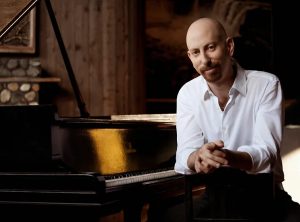
AN: I come from a highly-musical family. My mother was a professional concert pianist, as was my eldest brother, who played both piano and violin. My father did not make a career in music, but he did sing opera in his twenties, and he always retained a passionate love for music. Given the proximity to a piano in our household, when my musical interest began to surface, it was an organic transition for me to express that musical interest on the piano, first in the form of childish doodling, then more formally as my mother first “showed me the ropes” before handing me off to a wonderful teacher for more formal studies.
ML: You have been extremely successful at the world’s most prestigious piano competitions. Could you share a bit about the experience of competing—how do you prepare; how do you deal with nerves; how do you motivate yourself to practice?
AN: Competitions always served as goalposts to catalyze my very best quality work through the imposition of a pressured performance environment. My first teacher entered me in countless local and regional competitions, and, as I grew older these expanded in scope to the international level. I became adept at preparing programs through systematic practicing, always keeping in mind the end-goal and practicing day-by-day to achieve those aspirations. Pressure became second-nature to me, so, while I do feel a normal nervous energy before a performance, I have coped with that feeling for so long that it is not a deterrent to performing at my highest level. I have never had to motivate myself to practice, as practicing is my motivation in and of itself; there is just about nothing I enjoy more than practicing the piano.
ML: You are an accomplished composer with an extensive repertoire, including both large symphonic works and smaller chamber works. Please share a bit about the process of creating an original composition.
AN: Composing often starts with a little earworm, which can take the form of a strain of melody or harmonic progression. When these sit with me for long enough to inspire me to do something them, I then more actively engage in the process of improvisation. Through improvisation I am able to unpack the potential in those ideas, which then catalyzes the process of bona fide composition through which I can expand my ideas to fit the formal structure the piece requires.
ML: You have a large piano studio—what are qualities that you look for in a prospective student? Best piece of advice that you give to your students?
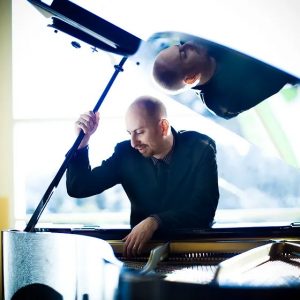
AN: The quality I most value in my students is curiosity. The more curious the student is, the more potential to delve as deeply into the craft of piano playing and help that student to achieve maximum potential. Of course, a solid work ethic and innate passion for music are a must, as well! The most salient advice I can offer my students is to make small steps forward each day and trust the process of achieving transformational change over time.
ML: Favorite hobbies and activities when not performing? Last book that you enjoyed? Favorite movies?
AN: As for hobbies, I am a gym rat, so I enjoy bodybuilding and sports in general. I don’t play competitive sports because of the risks to my hands, but I do also love to read and watch movies. I recently delved into the Silmarilion by J.R.R. Tolkein, and I enjoyed watching the movie, Matrix Resurrections.
Our sensational November soloist, flutist Lorna McGhee, took a few moments from her busy performing and teaching schedule to share her thoughts with SOR Artistic Director, Maria Larionoff. We look forward to welcoming her to Missoula on November 20th!
ML: Do you come from a musical family?
McGhee: Yes, although they were not professional musicians they had a great appreciation for music. My dad was a schoolteacher, and mum was a stay-at-home mum. Dad loved opera, and mum had a beautiful alto voice and sang in various choirs. It was important for them to expose my sister and me to music through going to concerts, listening to lp’s, and taking up instruments. My sister and I started piano lessons at quite a young age, and then my sister took up the violin (she got to quite a high level she did not go into the profession) and then I took up the flute. There was always music in the house and I really appreciate my parents for that!
ML: What made you choose the flute as your instrument?
McGhee: I credit James Galway with that. When I was growing up, he had already left his position as the Principal Flute of the Berlin Philharmonic and was very frequently on the chat shows on tv where he would perform. I remember just being dazzled by the sounds that he could produce on this wonderful instrument. He really brought it to life for me and I’m so grateful that he dedicated his life to being a great musical ambassador. At home my parents would also put on a recording of Peter and the Wolf and my sister and I would try to guess the instruments—of course the flute is really sparkly in Peter and the Wolf, so it left quite an impression. So—I think it had something to do with these two issues—James Galway and Peter and the Wolf combined!
ML: In addition to your position as Principal Flute of the Pittsburgh Symphony, you regularly perform with some of the world’s great orchestras. Can you share what that experience is like for you?
McGhee: Performing as guest Principal Flute is an interesting experience because each different orchestra has its’ own internal culture. Some orchestras are very disciplined, very clean, maybe less tolerant of taking risks, and then some orchestras–especially the London orchestras—are fearless, and I love that! They play with a lot of trust in themselves and a lot of trust in each other, they are so quick to respond to each other and function so brilliantly as a unit, you know, they’re not waiting to be directed, they take a lot of initiative. I love that fearlessness! In some of the chamber orchestras, such as Academy of St. Martin’s, Chamber Orchestra of Europe or the Scottish Chamber Orchestra, where you are playing more classical or baroque repertoire, I really appreciate the stylistic qualities such as attention to detail and the transparency and lightness. In Pittsburgh what I really value is the beautiful attention to detail but also this orchestra plays with a lot of heart—they never ever play without heart, and I value that tremendously.
ML: Do you have a favorite conductor?
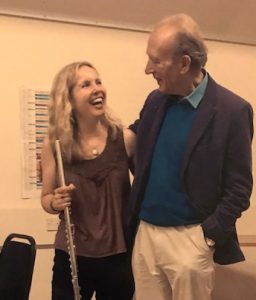
McGhee: My favorite conductor is Bernard Haitink, who recently passed away. I’ll never forget being in the European Union Youth Orchestra playing Mahler 9 with him conducting—that youth orchestra is, to this day, one of the best youth orchestras I have ever played in! Many of the wind section are now in Principal positions in the Berlin Philharmonic, Concertgebouw and the Bavarian Radio Orchestra, it was super high-level. What made it so special was that Haitink made music from such a place of love, he was so trusting of the musicians. He would just trust you to be able to do your best, then it just invites that from you, so you are not playing out of fear, you are playing out of being trusted and cared for. He would get tremendous results, much greater results than you could ever get by leading with fear. I admire his intellect, his humanity, and his reverence and devotion to the music. He just had this beautiful, natural authority without ego. I worked with him professionally in subsequent years, and when I knew I might not get the chance to work with him again I actually wrote him a letter, and just said “thank you for teaching me what it is to be a musician”.
ML: What is your favorite repertoire?
McGhee: There’s so much repertoire that I really love as a flute player! I think I especially love the music of Debussy and Ravel, it is just such great use of the instrument and the colors you can get from the flute. I have such a beautiful relationship to the sound of the flute and I’m just so in awe of their music, their imagination, the colors and textures. I would also say Bach—it doesn’t get much better than the B Minor Mass or the St. Matthew Passion. For flute players that is some of the greatest writing for the instrument—the beautiful obbligati parts that he wrote for the flute, such characterization. I also love Shostakovich, Mahler—I think I couldn’t do without Mahler—Schubert. If I had to choose just two, it would be the French composers and Bach.
ML: Least favorite repertoire?
McGhee: That’s an interesting one. I like minimalist music, I enjoy listening to it, but I don’t enjoy playing it because there’s no room for interpretation, you just have to execute it. I like to listen to it, but I don’t like to play it, I feel like I’m just a cog in a wheel.
ML: What are some of your favorite activities when you are not practicing or performing?
McGhee: Being in nature–I love to go hiking, love to be in the mountains. I also love to read a lot, to get lost in a book, love being transported to another world through reading. That opens up different perspectives that you might not have experienced yourself.
ML: What is the best advice you were given by a teacher or mentor?
McGhee: My old teacher in Scotland would say “Play as if your life depended upon it!” and I love that commitment. Why bother if you are not going to be completely committed to what you are doing? Why would you listen? Why would you expect anybody to listen if you’ve not completely committed to what you do? It’s an unspoken contract between you and the music and between you and the listener. I would say also that my teacher in London, William Bennett, was a great inspiration. There’s nothing really in terms of a pithy comment, but it was just his example of finding delight in every phrase. What is this phrase trying to say? How can I bring it to life? How can I animate that? He taught me that you should always say something when you make a noise on your instrument, always have your imagination switched on. I particularly love that attitude of taking delight in what you’re doing, taking delight in the phrase, having that joy in the music.
ML: We hope that you all enjoyed getting to know Lorna a little bit and hope to see you in our audience when she joins the musicians of SOR to perform concerti by CPE Bach and Chaminade on November 20th!
SOR Artistic Director Maria Larionoff chats with SOR Principal Cellist Adam Collins about his September 22nd UM Recital with acclaimed pianist Brain Locke and their upcoming Montana concert tour. Thanks to Adam for taking the time to share his thoughts with us!
ML: Could you give us a little background on what inspired this project?
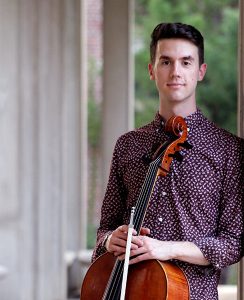
AC: I was thrilled to receive a grant from the Montana Arts Council this summer to fund an upcoming recital tour of Montana. The award came from funding from the Covid-relief American Rescue Plan Act (ARPA) and the arts council distributed over $800,000 dollars to arts projects across the state. I’m excited to see what all comes of this investment in the arts! With my award, I’m performing cello-piano recitals in Missoula (9/22), Kalispell (9/23), Helena (9/25), Fort Benton (9/26), and Billings (9/27) alongside a pianist from Chicago, Brian Locke. We’ll also visit schools in Fort Benton to engage with students who may not often get a chance to hear this type of music. Due to the grant funding, Brian and I are able to offer these concerts free of charge to attendees! I hope this will make the concerts more accessible to Montana audiences.
ML: You mentioned that you were focusing on French repertoire—how did you choose the specific works that you are performing?
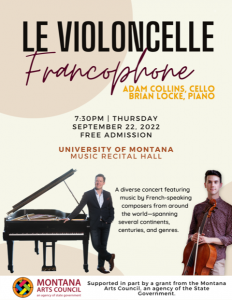
AC: I have always been a Francophile. I started studying French in school when I was eleven—this was quite the progressive option for a public school in rural North Carolina—and continued throughout the end of my undergraduate degree. By taking French courses each semester of college, I accidentally nearly double majored in cello performance and French! Between that, having a French roommate for a year, and spending three summers playing with l’Orchestre de la Francophonie in Montréal, I’ve developed a deep love for the French language and cultures from around the French-speaking world.
Francophone studies is a major area of academic work in French academic programs and I chose the music on this recital to explore the field from the musical perspective. I took classes in undergrad that explored French literature from Asian-Canadian, Haïtian, and North-African authors. The music on this recital reflects a similar organizing principle. There will be music by composers from France as well. The process of repertoire selection involved a lot of research. I combed through library catalogues, recordings in various formats, and the resources of organizations such as the Société de Recherche et de Diffusion de la Musique Haïtienne. In the end, Brian and I put together a recital program that spans several continents, centuries, and genres.The final lineup includes Francis Poulenc’s Cello Sonata, Julio Racine’s Sonate à Cynthia, Maurice Ohana’s Noctuaire, Nadia Boulanger’s Trois Pièces, and transcriptions of songs by Ania Vu, Gabriel Fauré, and Édith Piaf.
ML: Is the pianist someone whom you collaborate with regularly?
AC: The pianist, Brian Locke, and I have actually never performed together! We met over a decade ago when we were both students at the Brevard Music Center’s summer institute. We’ve been scheming about recital ideas ever since and this grant became the perfect opportunity to make one happen. It’s quite the undertaking to organize a tour of this scale so it’ll be a trial by fire! I am so excited to finally get to work with him.
ML: When you are performing in a different venue every night how do you adapt to the different acoustics?
AC: This is a great question! Adjusting to different acoustics is quite the challenge. However, dry and reverberant spaces have their “opportunities”. Venues with lots of reverb can be satisfying to play in but can result in muddy textures. The long resonance of each note can obscure the others around it until you’ve got only an imprecise resemblance of the piece. To compensate for that context, we might take slower tempi, use shorter and crisper articulation, and less pedal on the piano. In drier spaces, the notes decay quickly in the room and this can result in a loss of a sense of richness or integrity of musical line. To counteract that, I’m care to sustain every note fully and to even slightly lengthen short and fast notes to be sure the pitch and beauty of every note is clear.
ML: What to you enjoy most about touring, and what is your biggest challenge?
AC: The best thing about touring is the opportunity to explore repertoire through repeated performances with different audiences. Practicing to prepare a performance takes so much time and effort that a one-off performance feels somewhat anticlimactic. Multiple performances allow me to get to know the music more completely. Furthermore, experimenting slightly each time to find something new in the music with each performance is so much fun. The biggest challenge thus far for this tour has been the logistics. Coordinating the concerts with venues, deciding on flights, producing posters, and those other logistical and promotional items are time-consuming and a bit out of my wheelhouse. I’ve learned quite a lot in pulling this together! I am so relieved when the business of the day is finished and I get to sit down with the cello and practice. The Poulenc Sonata is one of the more difficult chamber works I’ve ever learned and it feels like the easy part of the tour compared to the organizational tasks!
ML: Wishing you both a most successful tour. This sounds like it will be an exciting and rewarding week for both performers and audience alike!
All of us at SOR are very excited to welcome Amit Peled as our featured soloist when we return to the UM concert stage to begin our 37th year of great string music. We cannot think of a happier way to celebrate the start of a new season! Amit graciously took the time to share his thoughts on a variety of interesting topics with Artistic Director Maria Larionoff—we hope you enjoy catching up with him before his concert in September.
ML: Do you come from a musical family?
AP: I come from a family of farmers—my grandfather raised turkeys. My parents lived on a kibbutz, so we grew up in the fields. My grandfather played the violin, and my mother played piano and sang, but they both realized early on that they had to support a family, so music became more of a hobby. There is a funny anecdote about my grandfather—when my grandparents got married, they had no money to buy any furniture for their home. My grandfather took the little money they had and spent it on an LP (record) player. Every Friday evening the whole village would come over and listen to classical music together—that was more important to him than having some furniture to sit on!
ML: Please tell us a little about your instrument.
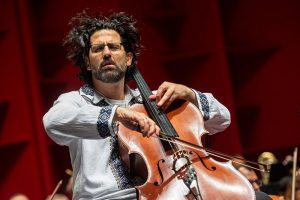
AP: From 2012 to 2018, I was very fortunate to have been loaned the Pablo Casals Gofriller cello. It was a great journey to be able to perform on one of the most famous instruments in the world and playing on it helped me find my own musical voice. Recently I have been loaned a 1695 Grancino cello from the Roux Family Foundation; this is the instrument I will have with me at the concert in Missoula. It is a beautiful instrument, I call it “Shoko” which means “hot chocolate” in Hebrew. The sound of this cello reminds me of drinking hot chocolate on a winter day.
ML: You have a phenomenally successful cello studio. What do you enjoy most about teaching? What do you find to be the biggest challenge in teaching?
AP: I love the combination of teaching, performing, and having a family. I call this the “triangle” of my life—being on stage, being in the studio sharing knowledge and ideas, and having a family—my wife and three kids, whom I really cherish. The balance between the three creates the triangle of my life.
What I love most about teaching is to just put water on a seed and see how it grows. Every flower, every seed, even if it’s the same method, grows differently and it’s very beautiful to watch and to guide. I find teaching to be an exchange between professor and student. It’s not a dictatorship, it’s a dialogue. The personality of the students, the ability to observe knowledge and to become “yourself” is very important to me. Having said all that, I think that sharing the knowledge that I was fortunate to get from my teachers is very important. It is as if you were in medical school—you don’t really get the knife to cut into the body in your first year, but you read books and memorize knowledge—I feel that the Bachelor’s degree to a certain extent is this—you have to observe the methods and only after you master the vocabulary can you come up with your own musical language.
The biggest challenge for me as a teacher is to teach two things—it only comes down to two things! The first is to make sure my students are curious, and the second is to make sure they are flexible. After twenty years of teaching, I find those to be the most challenging things. If they become curious they can continue to learn by themselves, and if they are flexible, they can make music with other musicians, which is never the same as playing alone in a room by yourself. I do find that balance between being flexible and curious is hard for me to teach—when someone is just copying what I tell them and writes down exactly my fingerings and bowings and my ideas, that’s not teaching—it is coaching. Teaching is to make them understand why I do those things on a certain day—tomorrow it might all be different—and having them come up with their own ideas and solutions. My biggest joy in a lesson is to argue with a student when they have an opinion of their own and their opinion is based on knowledge. Occasionally, I even take a coin from my pocket and offer to buy what they just said, because it’s a better solution than what I had in mind!
ML: You have added conducting to your career in recent years, both as Music Director for the Mount Vernon Virtuosi, and CityMusic Cleveland. Tell us a bit about the experience of conducting—was it a natural outcome of your many years as a soloist working with so many conductors around the world? Does your work as a conductor come from a desire to teach and coach?
AP: Conducting is a very organic thing for me to do because I feel it’s a better way for me to approach a bigger number of students and people and dive into repertoire that I cannot do just as a cellist. I don’t really want to call myself a conductor, even though I studied it in college—doing it is a big joy. I learn so much from it—psychologically, in how to deal with a big group of people and make people play their best for me—this takes great communicative skill, to inspire musicians to rise to the occasion of performing these great works. When I started studying symphonic scores I took every opportunity to sit down with experienced conductors over a glass of wine and ask them to share their knowledge with me so that I could benefit from their wisdom.
ML: I had the privilege of working with many extraordinary conductors in my years in the LA Phil, and in my violin studio I have photos of Carlo Maria Giulini, Simon Rattle and Zubin Mehta on the walls. Who are your favorite conductors, living or not?
AP: Probably my biggest hero as a conductor is Carlos Kleiber. I love watching him—he’s like a painter of sound. Another one is Sergiu Celibidache, even though his tempi were quite slow when he was old—his control of the creation of sound is something that I’ve never seen before. I emphasize seen, not just heard, because you can actually see how he creates the sound with his body, his hands, and it’s an amazing feeling to see that!
ML: What are your favorite activities when you’re not playing the cello?
AP: I love working with clay or ceramics. The time I spend alone sitting in the studio working with clay is very valuable to me and I find it very inspirational. I also love watching sports with my kids, especially basketball.
ML: Do you have any insights to share from the past year in quarantine during the pandemic?
AP: I spent more time looking into myself, and spent more time with my family, which was very precious to me. I called it a forced sabbatical, which was really great! I was not a big fan of online teaching before the pandemic, but in order to continue my teaching work, I did create an online month-long Cello Academy that was immensely popular. We had over 50 cellists from all over the world—from Hawaii, Korea, Australia, Saudi Arabia, who would join me on Saturday mornings. Normally, I would not be able to connect with so many cellists in this way, so I am very grateful to have had this opportunity, and I do plan to continue this Academy in April 2022.
ML: There is a famous story about the violinist Jascha Heifetz. After a concert one of his fans asked him “Mr. Heifetz, what is the most difficult concerto to play?” and he responded: “They’re ALL tough!!” What is the hardest thing to do on the cello, and what is the easiest thing?
AP: Everything is hard! Playing Haydn is hard, playing a one-octave scale is hard—just depending on how well you want to do it. If you strive for greatness every single day that you play the cello or do anything in life, it’s gonna be hard. However, it’s really rewarding to achieve it or to try to always get better. The day I feel I have achieved everything will be the day I put my cello back in the case forever, and I don’t want to be in that position! I always want to be striving for more, so in this way, music keeps me alive—new ideas, new collaborations—that’s the joy of it.
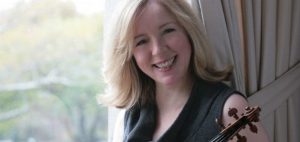
SOR looks forward to welcoming Stephanie Chase as our April 2022 soloist. Acclaimed for her “rich, passionate tone, dead-true intonation throughout and virtuosity galore” (Gramophone), Stephanie made her Chicago Symphony debut at age eight, and went on to win the top prize in the prestigious Tchaikovsky Competition in Moscow. She is a recipient of the esteemed Avery Fisher Career Grant and has appeared as soloist with over 170 orchestras around the world! SOR’s Artistic Director Maria Larionoff caught up with Stephanie between her concert tours and had her share some thoughts on music and her other interests.
ML: Who is the musician that you look to for inspiration? Favorite recording?
SC: Arthur Grumiaux, who was my teacher starting when I was 18. He was a beautiful musician whose recording of the Bach Sonatas and Partitas for violin solo are probably my favorite, followed closely by recordings that he made with the Grumiaux Trio.
ML: What are your five desert island pieces?
SC: I always find it hard to limit my favorite works to play, but they would include Bach’s Sonatas and Partitas and probably some Bartok string quartets, the Sibelius Violin Concerto, Beethoven’s Tenth Violin Sonata and Schubert’s cello quintet.
ML: Please describe your routine on a concert day. How do you stay focused, do you have any special things that you like to do?
SC: My usual routine would be to have a rehearsal with the orchestra or pianist (for a recital), a fairly long walk, some slow practicing, and a nap!
ML: How do you motivate yourself to practice?
SC: Fear of playing poorly in a concert! Every time I play a work I try to make it a better and more profound version than the previous one.
ML: What do you like to do to relax?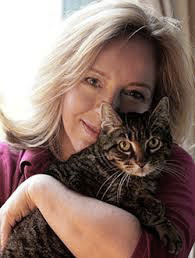
SC: One thing I do is to play spider solitaire on the computer–I’m currently at the expert level with four suits. At my 18th century house in northwest Connecticut, we have about eight acres that include gardens and forested areas, and I enjoy taking care of them and just exploring the property. This week I got out the pole saw and was pruning trees and taking down some smaller dead ones, to help prepare for spring, and discovered yet another blueberry shrub. I’m also on a quest to identify the trees, plants, and wildlife that we have, including some rare apple varieties in our small orchard. Among the wildlife here are black bears, coyotes, deer, fox, a bobcat, opossums, and even some moose and bald eagles nearby. I know that this is a paltry list compared to Missoula, but we are just 100 miles or so from New York City, which has an extensive suburban perimeter.
ML: What is your favorite comfort food?
SC: My husband is an excellent cook and I really enjoy just about anything he makes, but if I had to name a favorite cuisine it would be Straits Chinese like you find in Singapore. It features fresh seafood and has Indian and Malaysian influences. Beyond that, I’m a real fan of good fried chicken and mashed potatoes.
ML: What is the last book you read? Last movie you watched?
SC: I am currently reading Eugenia Zukerman’s Like Falling Through a Cloud. She is a true Renaissance woman, a prominent flutist, journalist, and arts correspondent for television and other media, and former artistic director of the Bravo! Vail festival along with many other achievements. In recent years she was diagnosed with cognitive decline and has written this inspiring book of verse that reveals her anxieties, but also what comforts her. I’m interviewing her for my next article for the online journal Stay Thirsty. As for movies, we rarely go. The last movie we attended in a theater was Ocean’s 8, mostly because it involves a heist during the Met Gala and my husband worked there for many years as the conservator of the musical instrument collection. We do watch movies at home, though, and I’m a Law and Order fanatic.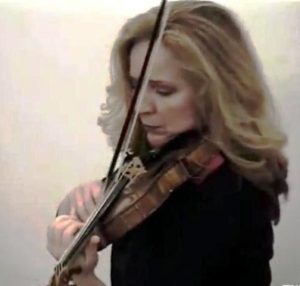
We hope you have enjoyed getting to know Stephanie a bit before our April concert, and we invite you to visit her website: www.stephaniechase.com.
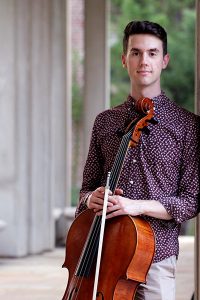 SOR Artistic Director Maria Larionoff took some time to visit with our February guest lecturer, Dr. Adam Collins, the popular UM Professor and the newest member of our SOR “family”. Adam’s MOLLI (Montana Osher Lifelong Learning Institute) series on Beethoven was completely sold out last year, and we are very fortunate to have him share his expertise with us on our SOR concert for a discussion on Beethoven’s life and music. Please enjoy reading about Adam and getting to know him as he shares his thoughts on music, food, and hobbies, and we hope to see you at our February concert!
ML: Do you come from a musical family? Was the cello your first instrument, and what made you choose it?
AC: I don’t come from a musical immediate family but my grandparents did have a piano in their home—a remnant of some of my mom’s siblings and my grandma’s piano lessons when they were growing up. I was thoroughly fascinated with the piano when I was very young and my grandparents gave my family the piano when I was six. I started lessons on piano immediately, but already knew I wanted to eventually play an orchestral string instrument. A childhood obsession with the movie Fantasia and an elementary school field trip to hear the NC Symphony had cemented that idea in my mind. Piano was simply the first available instrument for me to study. My dad and I attended the school orchestra interest meeting in the fourth grade and I was transfixed by the sound of the cello when the teacher demonstrated a few notes. My dad attempted to persuade me to take up the violin instead—the cello was larger than me at the time—but I could not be deterred. My piano teacher was also a string player so I started weekly cello lessons right away. I continued with both cello and piano until high school when I switched the cello full-time. I still play the piano enough to demonstrate topics in music theory classes but would never perform publicly.
ML: You regularly perform in many varieties of ensembles, from principal cello in large orchestras, a member of string quartets and other chamber ensembles, and most recently as our newest member of SOR. Can you share some of the challenges and joys that you find performing in these different groups?
AC: Every type of group has its own challenges and rewards. Large symphony orchestras have endless possibilities of sound color combinations and immense power of sound. Performing orchestral climaxes in music by Mahler or Straus is an unparalleled experience. After all, the visceral power a full orchestral sound was what originally drew me into music. While the communal process of creating music with 100+ musicians creates an instant sense of bond with all the other performers, it is a somewhat artificial bond. My main challenge with orchestral playing is that it’s hard to actually know the people on stage with me. As a result, the musical experience for me as an orchestral performer can seem somewhat impersonal or anonymous. Conversely, this is precisely why I enjoy playing smaller groups such as string quartets or the String Orchestra of the Rockies. The smaller the group, the larger a personal impact that I feel I have on a performance. Furthermore, it is much easier to establish personal bonds beyond the music with my other performers in these other contexts. What smaller ensembles might lose in sheer acoustic power, they make up for intimacy and personal involvement in the music-making.
ML: You are a passionate advocate of discovering and promoting new composers and contemporary music. What draws you to certain works, and how do you choose new repertoire?
AC: My passion for contemporary music is rooted in my obsession with finding new musical experiences. I’m constantly attempting to recreate the feeling of the first time I heard the Fantasia film score, a live orchestra, or the cello. I am drawn to pieces that have instant visceral appeal, be it in the form of direct emotional expressivity or a fascinating or unusual tone color. Pieces that really excite me sustain these qualities while demonstrating clear formal and compositional processes. Composers whose music I most admire are able to write music of immediate impact that holds up to analytical scrutiny and repeated listening. While an audience might hear a piece only once, I have to hear it endlessly in the practice room as a performer. Compositional complexity makes the repetitive preparation process much more rewarding. Beethoven’s music is a great example of this type of music: it is both immediately gripping and intricately constructed with small motives. I choose new repertoire by listening to the recommendations of friends and following rabbit holes on YouTube, Spotify, and other online resources. The internet makes it easy to find pieces and composers outside the celebrated canon. A small amount of due diligence opens a world of new experiences—for myself and my audiences—and is well worth the effort. Furthermore, classical music has long neglected the contributions of women and people of color. I do actively seek out music by underrepresented groups to work against this injustice.
ML: What do you enjoying doing in your free time? Favorite places to eat in Missoula? Hobbies you cultivate?
AC: A few of my hobbies include hiking, running, and cooking (baking bread especially). I started a sourdough starter 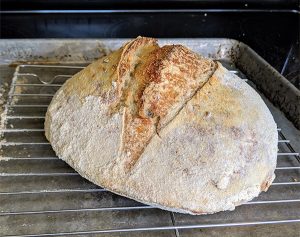 when I moved to Missoula in 2018 and it’s still going strong! I am a novice to breadmaking but, fortunately, it’s a forgiving medium. Even mediocre homemade bread is still homemade bread. Cooking is a complementary hobby to cello for me because its results are necessarily shareable. Just like music, it’s not that rewarding to make food or bake bread without sharing it. I also try to spend as much time ou tside as possible. I live fairly close to a trailhead for the
 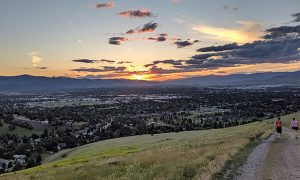 Pattee Creek Canyon/Mount Sentinel trail system, and I often spend an entire afternoon on those trails, listening to podcasts or audiobooks. It’s great exercise and the perfect antidote to any amount of burnout I might experience mid-semester. Being outside in Missoula is itself a reminder of how much I love being here and doing all that I do. While I don’t eat out too often, my favorite restaurant in Missoula is Biga Pizza. Their dough is so flavorsome and all of the topping combinations that I’ve tried are delicious; everything on the menu is a good choice. Biga Pizza was also one of the first meals I had in Missoula (at the home of another SOR musician and my colleague at UM, Margaret Baldridge), so there’s a certain amount of nostalgia baked into every bite for me, as well.
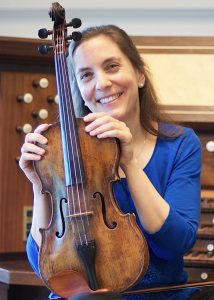 String Orchestra of the Rockies is thrilled to welcome celebrated Missoula native Maria Lambros as our featured soloist at our November concert. She took a few moments to answer some questions with Artistic Director Maria Larionoff about her incredible journey as a successful chamber musician, soloist, and pedagogue, and also to share a few of her favorite things about Missoula. We hope you enjoy getting to know Maria before hearing her play in November!
ML: Was the viola your first musical instrument, and what was it that made you want to become a violist?
Lambros: I started on the violin because my Mom had the great insight to know that it was a good fit for a child who loved to use her hands cutting paper and making things. To me, it was a magical thing, and I loved it right away. Much later, when I was at Sentinel High School, the Trio D’Accordo: Jorja Fleezanis (SOR’s soloist last spring!), Yizhak Schotten and Karen Andrie, came to my school and played the Dohnanyi Serenade for String Trio. I was completely taken with the gorgeous viola solo in the Romanza and the violist’s deep, velvety sound. Immediately, I started listening to as many viola recordings as possible–I became a viola fanatic! Missoula’s KUFM had a listener request program on Thursday evenings and every week I would call in and ask for a different viola piece, often changing the tone of my voice so that the host, David Kappy, wouldn’t know it was the same person. Well, he figured it out (“SOMEBODY out there really loves the viola!”) and one night he devoted an entire show to music for the viola. I was so excited that I recorded it from my little cassette player and listened to it until the cassette actually broke. A year later, I switched to viola and started college on that instrument.
ML: Besides classical music, what types of music and artists do you listen to?
Lambros: My jazz musician friends Michael Formanek and Mark Feldman turned me on to jazz, mostly the classics like Miles Davis, John Coltrane, etc. I love old rock ‘n roll such as The Beatles and Led Zeppelin. On long car trips, we love listening to Willie Nelson and Elvis. Our favorite klezmer artist is clarinetist Giora Feidman- check him out–he’s amazing! And, I even enjoy some heavy metal (Opeth, Between the Buried and Me, Dream Theatre), due to the strong influence of my son, Daniel.
ML: Who were/are your mentors? What is the best advice they gave you, and what do you like to tell aspiring young musicians whom you mentor?
Lambros: My first wonderful mentors were from my growing up in Missoula. Eugene Andrie, my violin teacher, influenced me so deeply with his warmth, gentle manner and emphasis on listening to and playing with others–he would devote parts of many lessons to playing duets with me. Keith Henke, our beloved grade school conductor, taught us that music-making could be joyous and fun and he delighted us with his incredibly creative musical descriptions (“This needs to sound like elves dancing on a cedar chest!”). Our high school conductor, Harold Herbig, made music with amazing passion and humanity. He believed that we could do anything–he gave us confidence in our abilities by challenging us with the great symphonic literature. Later in life, my biggest influences were the members of the Cleveland Quartet, Robert Mann violinist, Paula Robison flutist, Kenneth Cooper harpsichordist, Sergiu Luca violinist, and Leon Fleischer pianist.
The best pieces of advice I can give young musicians are:
PRACTICE WELL. Practicing is about solving problems. Zero in on what is not happening the way you want it to and fix it, right away! No more practicing things over and over without really thinking about what you are doing.
Music is about character and telling stories. Engage your imagination and creativity at all times.
Play from the heart–it is key to connecting with others.
Play lots of chamber music! It is the best way to learn to listen.
Be grateful to be a musician–it is a great privilege.
At the end of the day, put people first.
ML: You have played in many professional string quartets throughout your career. Can you share what you love most about being a member of a quartet, and what you find the most challenging?
Lambros: I absolutely love the musical communication and intimacy between the foursome–it is endlessly fascinating, and the listening happens at such a heightened level. Four-string instruments have such a wealth of possibilities for matching intonation, bow strokes, vibrato, sound color, articulation–the challenges are endless! Working together with such intensity can be hard at times and people can really drive you crazy. The openness and flexibility required in a string quartet make a regular marriage seem pretty easy, for sure! Again, my motto is: PEOPLE FIRST. People are more important than what happens in the music. If you talk about difficulties openly and really try to UNDERSTAND another’s point of view, most of the time–but not always–you can work things out. Sometimes, it is not a healthy situation and the group should not continue, and that’s OK- there is another opportunity out there.
ML: You recently launched a program in Baltimore called Our Joyful Noise Baltimore. Can you tell us about it?
Lambros: Oh my… so much to say–this is what is really consuming my energy these days as I am so excited about this project! The vision of Our Joyful Noise Baltimore is a world where all people–regardless of the economic situation, disability challenge or circumstance–have easy access to the life-affirming splendor of live music. We bring a concert series of the highest professional quality to a veterans’ shelter, women’s prison, cancer treatment residence, and for families living with autism (our motto is: All Behaviors Welcome!) in the Baltimore community. We started our second season in September and the extraordinary effect the music is having on our audiences has exceeded our wildest expectations and has proved to us, over and over again, the incredible power of music and the importance of art to vulnerable populations. A veteran at the Baltimore Station recently told me, “Thank you, That was most excellent. It’s good to know that there are still things in life worth living for.” The impact on the musicians is significant as well; a Baltimore beatboxer and vocal percussionist who participated in our first set of concerts called it a “life-altering experience.” The last concert by folk musicians Dan and Claudia Zanes literally had the women in prison dancing in the aisles!
ML: My visits to Missoula never feel complete without a stop at my favorite places: Liquid Planet Grille for The Dude Abides sandwich; Caffe Dolce for gelato and a cappuccino, and Bernice’s Bakery to pick up doggie treats for our golden retriever. What are your favorite places when you come home to visit Missoula?
Lambros: Ah, I’m very low brow here because the nostalgia for my childhood kicks in with visits to Hoagieville, the Dairy Queen and Taco John’s. I love getting tea at Butterfly Herbs and pizza at Bigga Pizza. But I’d say I mostly hang out at Caffe Dolce, not just because my cousin owns it and I’m likely to run into a family member there, but because the food and ambiance are so fabulous!
ML: I understand you are a big Baltimore Orioles fan. Are there other sports/hobbies you would like to share?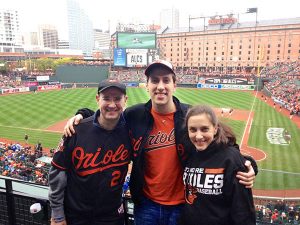
Lambros: Yes, despite the Oriole’s miserable season, we still love them. We (because my family does this together) follow the Baltimore Ravens and the Washington Capitals and try to go to several games each year. I love making things such as cards, quilts and books and have a serious Qigong practice. I’m the family historian–I love putting together scrapbooks of life stories; right now, my Dad and I are going through HIS father’s scrapbooks and are putting together his history for future generations to enjoy. My favorite thing–above all–is visiting my family in Missoula, San Diego, Seattle and Chevy Chase, MD and my son Daniel in San Francisco. I really wish I lived closer because I love them all so much!
I’m so excited to come to Missoula in November and play with the wonderful String Orchestra of the Rockies, a group that my parents describe as a Missoula cultural treasure.
ML: We are looking forward to it as well! Thanks for taking the time to share your thoughts and wisdom with us!
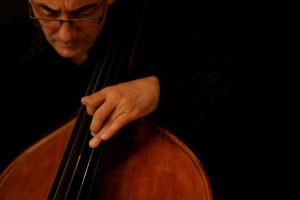 Our September guest artist, international superstar Catalin Rotaru, sat down for a brief interview with SOR Artistic Director Maria Larionoff and shared some of his musical adventures and thoughts on life.
ML: Was double bass your first instrument, and how old were you when you began taking lessons?
CR: I was about twelve years old when I began taking lessons, and yes, the bass was my first musical instrument. I do believe in destiny—that I came into this lifetime to do this on the planet. The universe arranges everything in your life, so you just follow the course that is pre-set. That is my personal take!
ML: You play a lot of concerti written for other instruments—Haydn cello concerto, Mozart violin concerto #5, Tchaikovsky Rococo Variations, Paganini violin caprices (wow!!). How do you select the repertoire for your arrangements?
CR: This is connected to what we just discussed about pre-destination. You know, as I am driving, I will hear some tune on the radio, one of these beautiful classical concerti, or maybe I am at a music festival and I hear another colleague performing something, or I can simply be at school in the hallways and hear somebody practicing a certain piece. Usually, if one of those pieces really sticks in my head the first question that pops into my mind is—can I do that on the bass? This is 99.9% of how I chose these pieces. I simply grab the original part that the music was written for and try it on the bass. Most of the time it actually works! I think there were a couple of exceptions where it was unplayable on the bass, so I gave up.
ML: You tour and perform constantly all around the world. This summer I know your itinerary included Taiwan, Germany, Amsterdam, and Mexico, among other places. My husband, double bassist Barry Lieberman once said that traveling with a bass is like going on a vacation and taking your refrigerator with you! Can you tell us what it is like to constantly travel with your bass? Where are your favorite places to visit?
CR: Traveling with the bass is not an easy feat. Often airlines will give you a hard time—this happened especially at the beginning of my solo career. After I built up some frequent flyer miles with the airlines they stopped asking me questions—of course, after you fly so much with them, they kind of trust you! I always have my flight case with me (a bass trunk) and I always check it in. In a way, it’s better than cellists, who have to buy an extra ticket for their instrument. It’s a little cheaper for me but much more risky—twice so far in my life they broke the case and the bass! But again, it comes with the territory.
As far as my favorite places to travel, that is a really hard question for me to answer precisely, to pinpoint one location on this planet. I just simply love the planet and everywhere I go I try to see the beautiful sights of every single place. Of course, they are some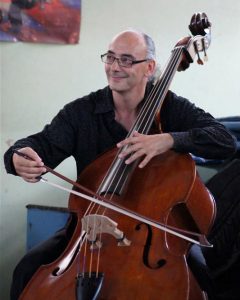 times quite different from one another in political, social, economic and developmental respects. I try to look at the positive aspects because I think this is the way we all should approach life.
ML: I know you are an avid movie buff, especially sci-fi and fantasy. What else do you like to do in your free time?
CR: Yes, I do like sci-fi and fantasy movies! I would also say that when I am traveling, walking through airports or driving somewhere, I listen to classical music and also audiobooks. Since I was a kid I have been obsessed with two primary subjects: existence and extraterrestrial life. And not just a little bit interested, but really obsessed! I am trying constantly to find answers to these questions: Who are we? Why are we here? Where are we going? This is a passion of mine.
ML: Thanks for sharing your thoughts with us Catalin—we are looking forward to hearing you play with SOR in September!